
THE NAME1957
Why it is called the Roostertail: the spray behind a racing hydroplane
One question, four documents, and a September 1957 blueprint that settles it.
The Roostertail is named for a racing term. A rooster tail is the wall of water an unlimited hydroplane throws up behind it at speed, reported as high as 75 feet, and it has nothing to do with a bird. Joe Schoenith, who built the venue in 1958, owned the Gale hydroplane team that won the 1955 APBA Gold Cup.
The name is a racing term
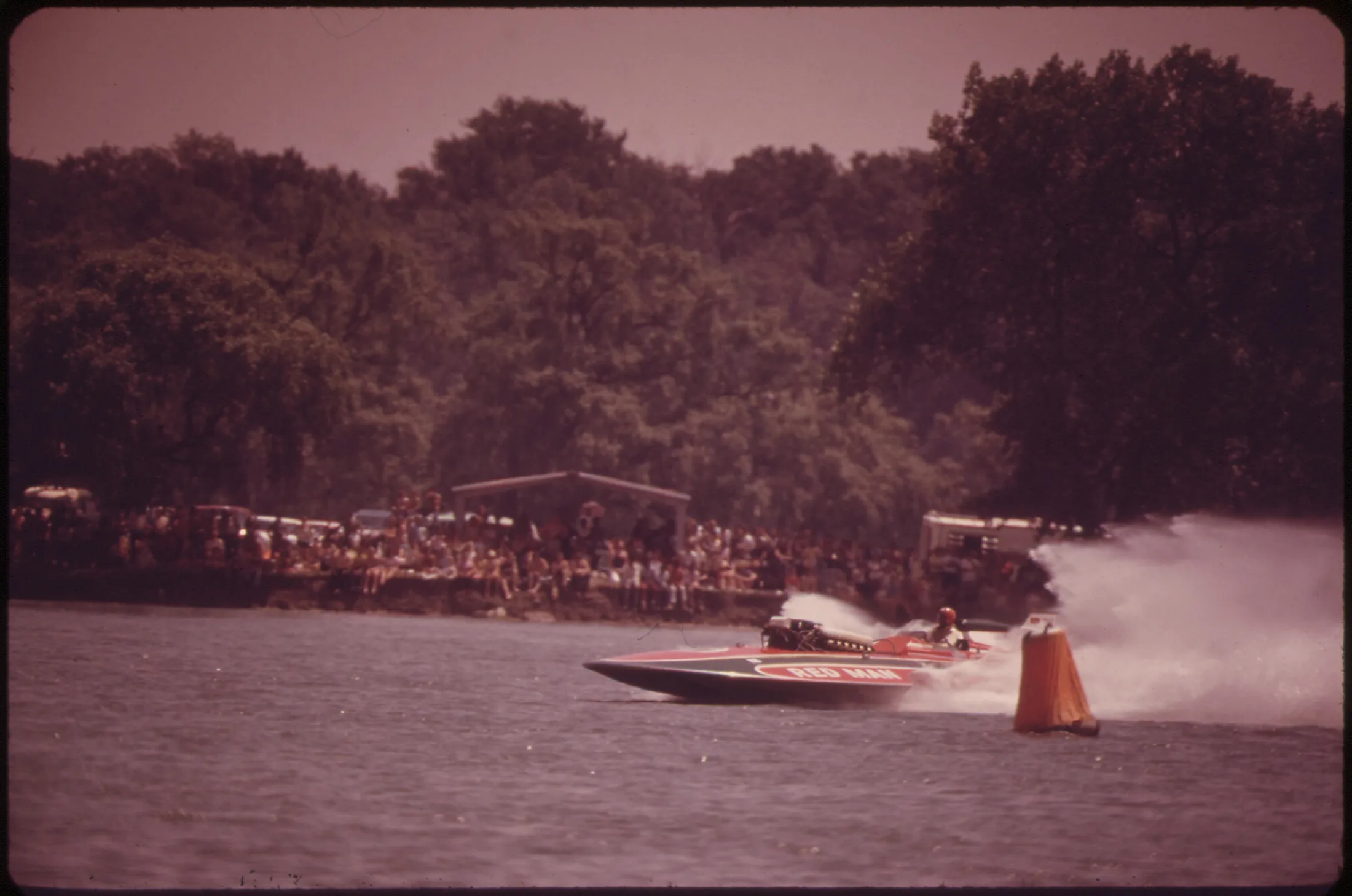
Rooster tail is a term from boat racing. It is the wall of water an unlimited hydroplane throws up behind its stern when the boat is running flat out. The venue is named for that water, and for nothing else.
The connection is direct. Joe Schoenith, who built the Roostertail and opened it in 1958, owned an unlimited hydroplane team. His boats threw that spray on the Detroit River, on the same stretch of water the building faces. He named a supper club after the thing his family was already known for.
This is the most common question the venue gets, so it is worth answering with documents instead of a story. There are four of them: a 1957 architectural blueprint, a 1959 matchbook, a race hull that carried the venue's name, and the shape of the race course itself.
Four documents: a blueprint, a matchbook, a race hull, and the race course itself.
What a rooster tail actually is
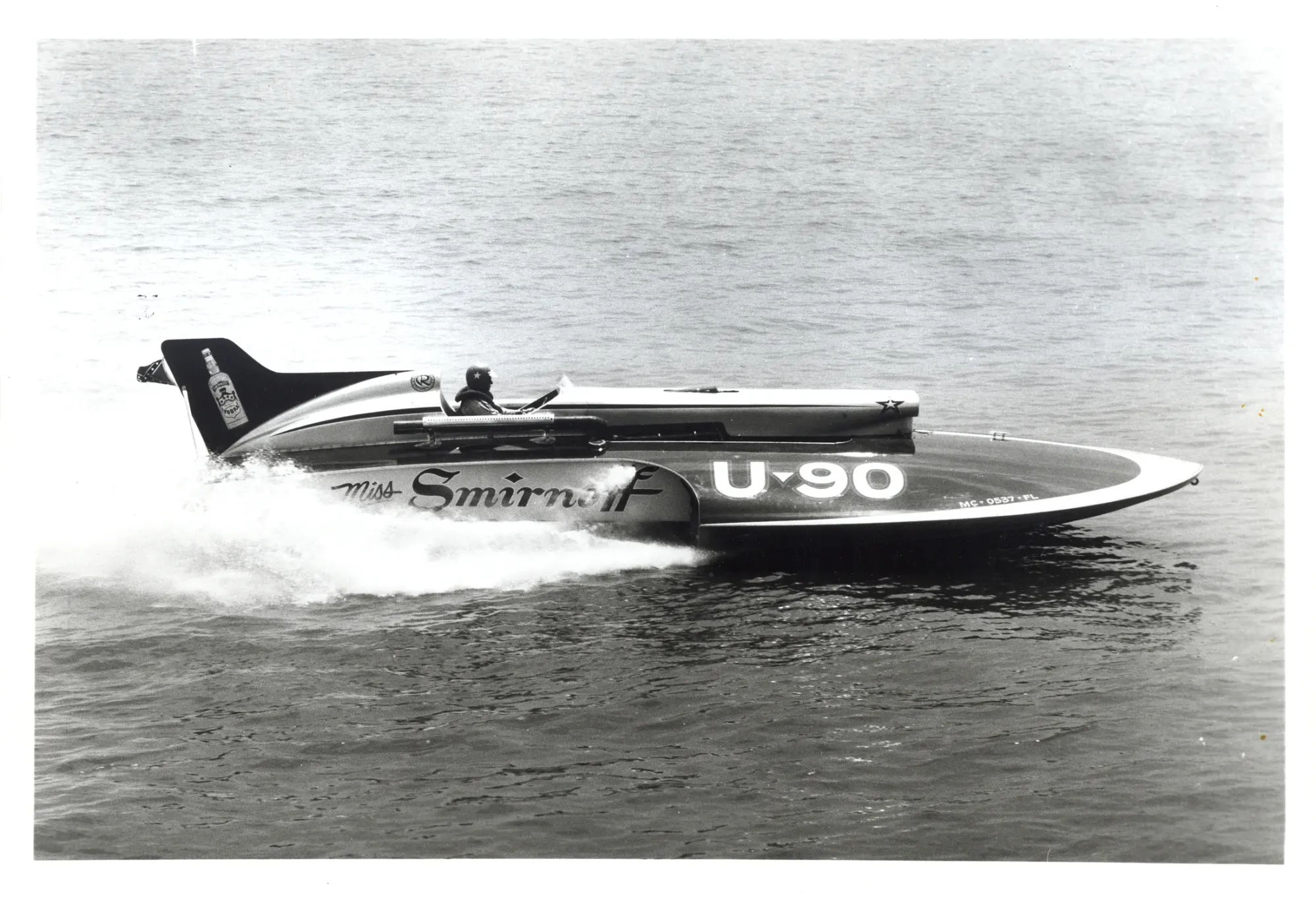
The spray is thrown by the propeller. Unlimited hydroplanes are the fastest class in powerboat racing, and through the years the Schoenith family raced they ran aircraft engines, Allisons and Rolls-Royce Merlins. Gale V, the hull that won the family its Gold Cup, was twenty-nine feet long and Allison powered. At racing speed the propeller drives water up and back off the stern.
Height is the part people remember. Hour Detroit, writing about the spray the venue is named for, puts the curtain of water at sometimes 75 feet. From a seat on shore it reads as a standing white wall behind a boat that has already gone past you.
None of this is abstract on the Detroit River. The city has hosted Gold Cup racing since 1916, after the community-owned Miss Detroit won the trophy the year before and brought the race home. At the sport's height, roughly half a million people filled the grandstands along the river on race day.
The curtain of water, sometimes 75 feet high.
Hour Detroit
Joe Schoenith owned the boats
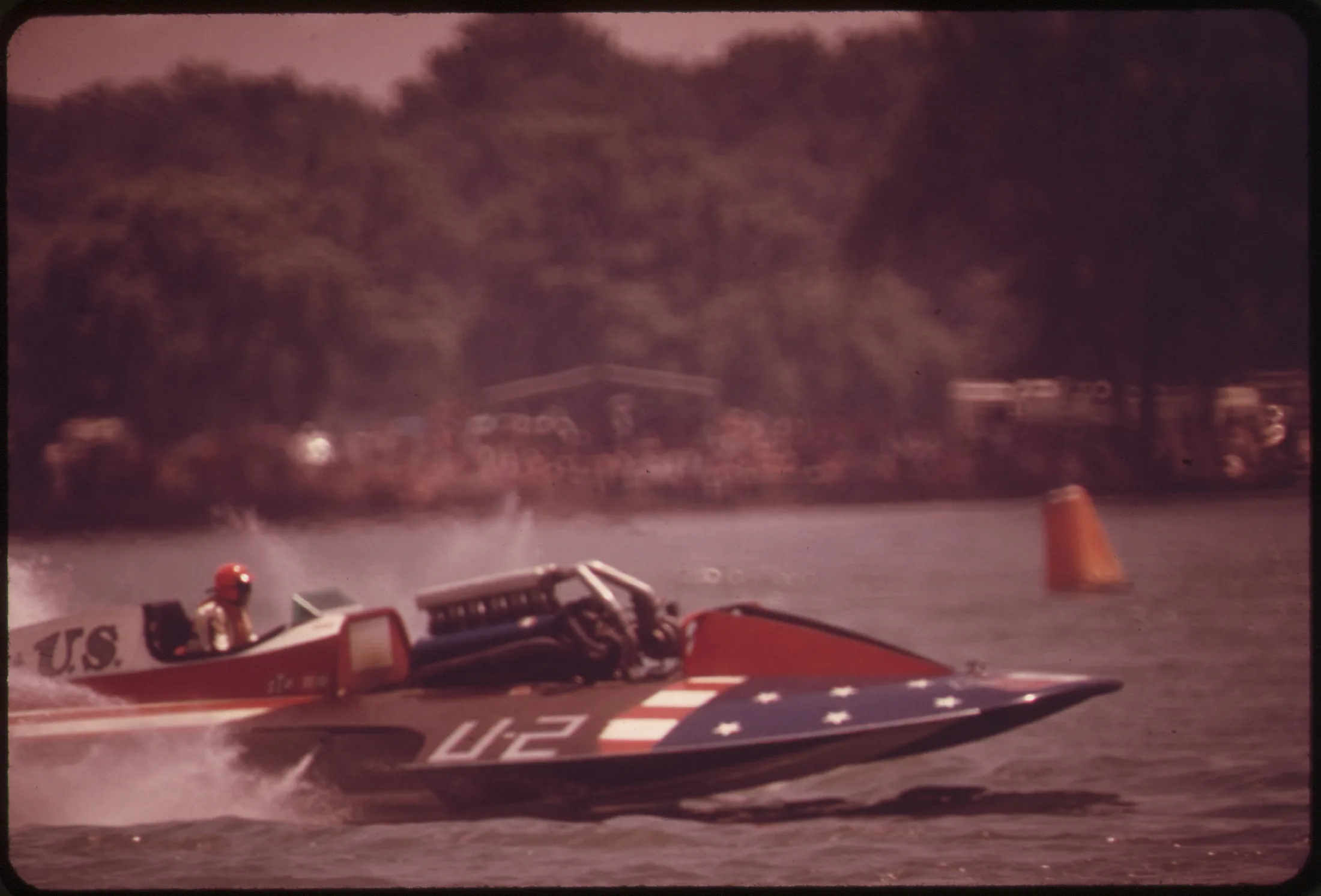
The money came from electrical work. Joe Schoenith bought W. D. Gale, Inc., a Detroit electrical contracting firm, in the 1940s, and promised the retiring owner he would never change the company name. He kept that promise on the water as well as on the letterhead. Every hydroplane the family campaigned raced as a Gale.
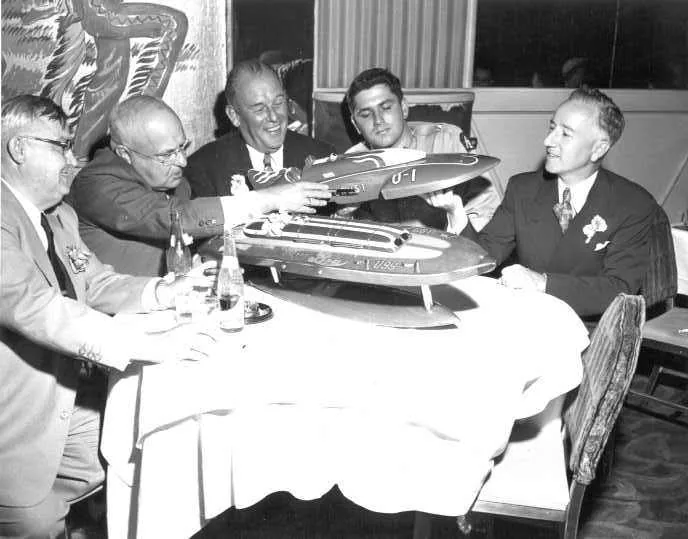
They started in 1950 with a used hull, bought when Joe's son Lee was twenty, renamed Gale and entered as U-50. Over twenty-six seasons, from 1950 to 1975, Gale Enterprises campaigned sixteen different unlimited hydroplanes and won twenty-seven races and four national championships. In 1954, President Eisenhower presented the team the President's Cup at the White House.
The high point came on August 7, 1955, on Lake Washington in Seattle. Lee Schoenith drove Gale V and did not win a single heat. He won the APBA Gold Cup anyway, on bonus points for the fastest aggregate time over ninety miles, by 4.536 seconds. It was the first time since the bonus system started in 1937 that a boat took the Gold Cup without winning a heat, and it ended a five-year Seattle hold on the trophy.
That was three years before the Roostertail opened its doors. When Joe Schoenith put a supper club on the river and named it for a hydroplane's spray, he was naming it after his own family's work.
Gale V won the 1955 Gold Cup without winning a single heat.
The name was on the blueprint before the building existed
The Detroit Historical Society holds the original drawing set for the building: five sheets by architect Edward M. Newman, catalogued 2013.049.468 through 2013.049.472. The first of them is the site plan, dated September 15, 1957.
Inked onto that working architectural drawing, alongside the property lines and the parking layout, is a hand-drawn Roostertail script logo with an illustrated hydroplane throwing its spray.
The date is what makes it decisive. The site plan is September 1957. The basement plan in the same set was still being revised on February 27, 1958. The doors opened in June 1958. The name and the boat were settled on paper months before there was a building to hang them on, which leaves no room for a later explanation invented to fit the name.
That drawn wordmark is the one the venue used for the next decade: a cursive lowercase script, always in a single flat color. It ran navy on the 1960s luncheon menus, white on the 1959 matchbooks, and in orange-red neon across the front of the building at night.
The name was inked on the architect's drawing months before there was a building.
The venue said so in print, and the boats said it back
A matchbook copyrighted 1959 by Roostertail, Inc., printed by Universal Match Corp. of Detroit, carries the address on the front, Marquette Drive on the Detroit River next to Water Works Park, over the line Detroit's Finest Restaurant and Cocktail Lounge. Open the flap and it reads: home of the GALE race boats.
That is the venue in its own printed words, in its first full year, telling customers the restaurant and the race team were one operation. A blue plastic swizzle stick from the same era makes the same point in the hand: the Roostertail script runs down the stick and the stirring end is molded as a hydroplane hull embossed GALE.
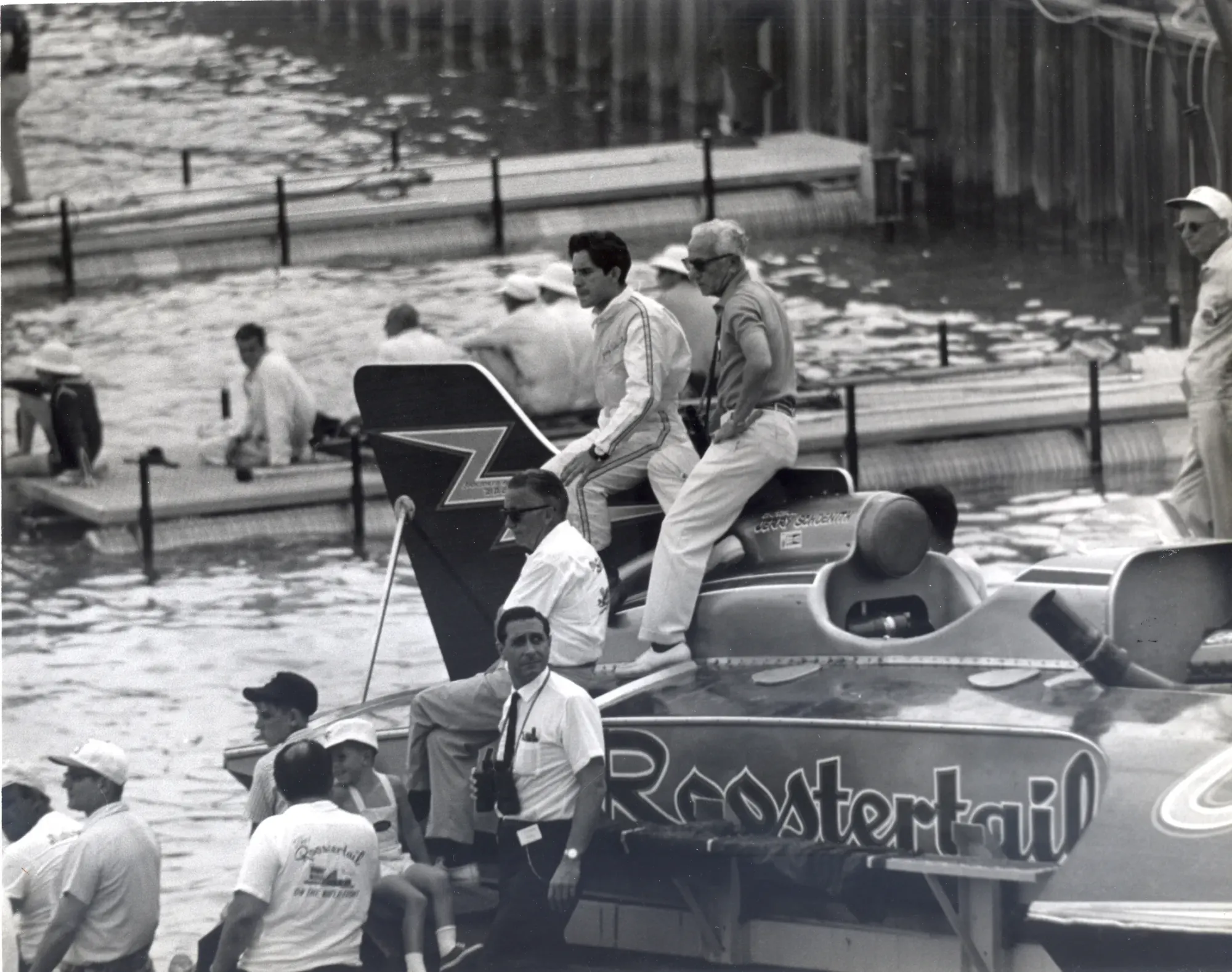
Then the name went back to the water. In 1966 a Gale Enterprises hull, the U-44, picked up a sponsorship mid-season and raced under a new identity, Gale's Roostertail. Bill Cantrell drove it. Jerry Schoenith, one of Joe's twin sons, drove it too, and Cantrell's final competitive race, the 1968 Diamond Cup at Coeur d'Alene, came as Jerry's relief driver in that boat. The same lineage of hulls carried the name again in 1973 and 1974.
A supper club was named after a race boat, and then a race boat was named after the supper club.
A supper club named after a race boat, then a race boat named after the supper club.
The building sits on the turn of the race course
The address is 100 Marquette Drive, on the Detroit River across from Belle Isle. The Gold Cup course is an oval run between the island and the mainland, and the building was put on a turn of it. Racing people know that corner by the venue's name, and it is described as the fastest corner on the circuit.
The Detroit Historical Society has the proof that the boats really did come that close. A black-and-white negative shot by photographer George Gellatly in June 1968 shows the hydroplane pit area at the base of Marquette Drive during that year's Gold Cup, an equipment truck and trailer in the foreground and the Roostertail Supper Club standing in the background. Ten years after the name was drawn on the blueprint, the boats were still pitting in the front yard.
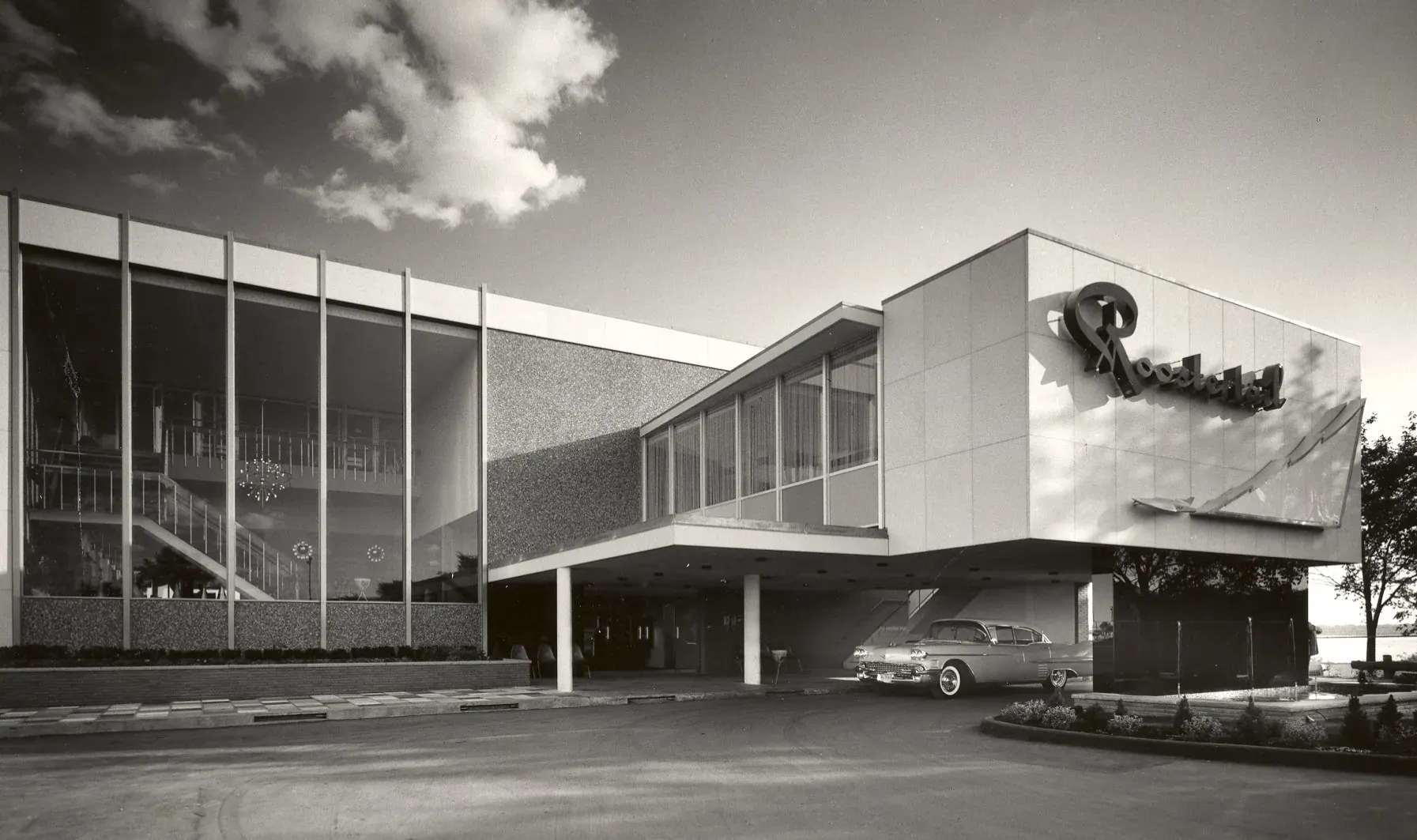
The site was chosen for exactly that. The original 1957 plan puts the Detroit River along the entire south edge of the property, and the building that went up behind it was mostly glass. What Joe Schoenith did in 1957 was point a wall of windows at a race course. The rooms behind that glass still look at the same water.
Questions people ask
- Why is it called the Roostertail?
- The Roostertail is named for the rooster tail, the wall of water an unlimited hydroplane throws up behind its stern at racing speed. Joe Schoenith, who opened the Detroit venue in 1958, owned the Gale unlimited hydroplane team that won the 1955 APBA Gold Cup. The building sits on the Detroit River race course where those boats ran.
- Is the Roostertail named after a rooster?
- No. The name has nothing to do with a bird. Rooster tail is a term from unlimited hydroplane racing for the tall spray a boat throws up behind its stern, and the Detroit venue was named for that spray in 1957 by a man who owned a championship race team.
- What is a rooster tail on a hydroplane?
- It is the curtain of water an unlimited hydroplane's propeller drives up and back at racing speed. Hour Detroit has described that curtain of water as sometimes 75 feet high. It is the most recognizable image in the sport, and it is what the Roostertail in Detroit is named after.
- Who named the Roostertail in Detroit?
- Joe Schoenith, a Detroit electrical contractor and unlimited hydroplane team owner, who built the venue at 100 Marquette Drive as a 50th birthday gift for his wife Millie. The name was fixed before the building was. The September 15, 1957 site plan held by the Detroit Historical Society already carries a hand-drawn Roostertail script logo with a hydroplane throwing spray.
- Was there a hydroplane named Roostertail?
- Yes. Gale Enterprises, the Schoenith family's racing operation, raced a hull under the name Gale's Roostertail. The U-44 took the name mid-season in 1966 with Bill Cantrell driving, and the same lineage of hulls carried it again in 1973 and 1974. The supper club was named for a race boat, and then a race boat was named for the supper club.
- Where does the Roostertail sit on the Detroit River race course?
- At 100 Marquette Drive, on a turn of the Gold Cup course that runs between the mainland and Belle Isle. Racing people know that corner by the venue's name, and it is described as the fastest corner on the circuit. A June 1968 photograph in the Detroit Historical Society collection shows hydroplane pits set up at the base of Marquette Drive with the venue in the background.