

THE SUPPER CLUB1959
Inside the Roostertail Detroit supper club, 1958 to 1979
Dinner at five thirty. The show from the same chair.
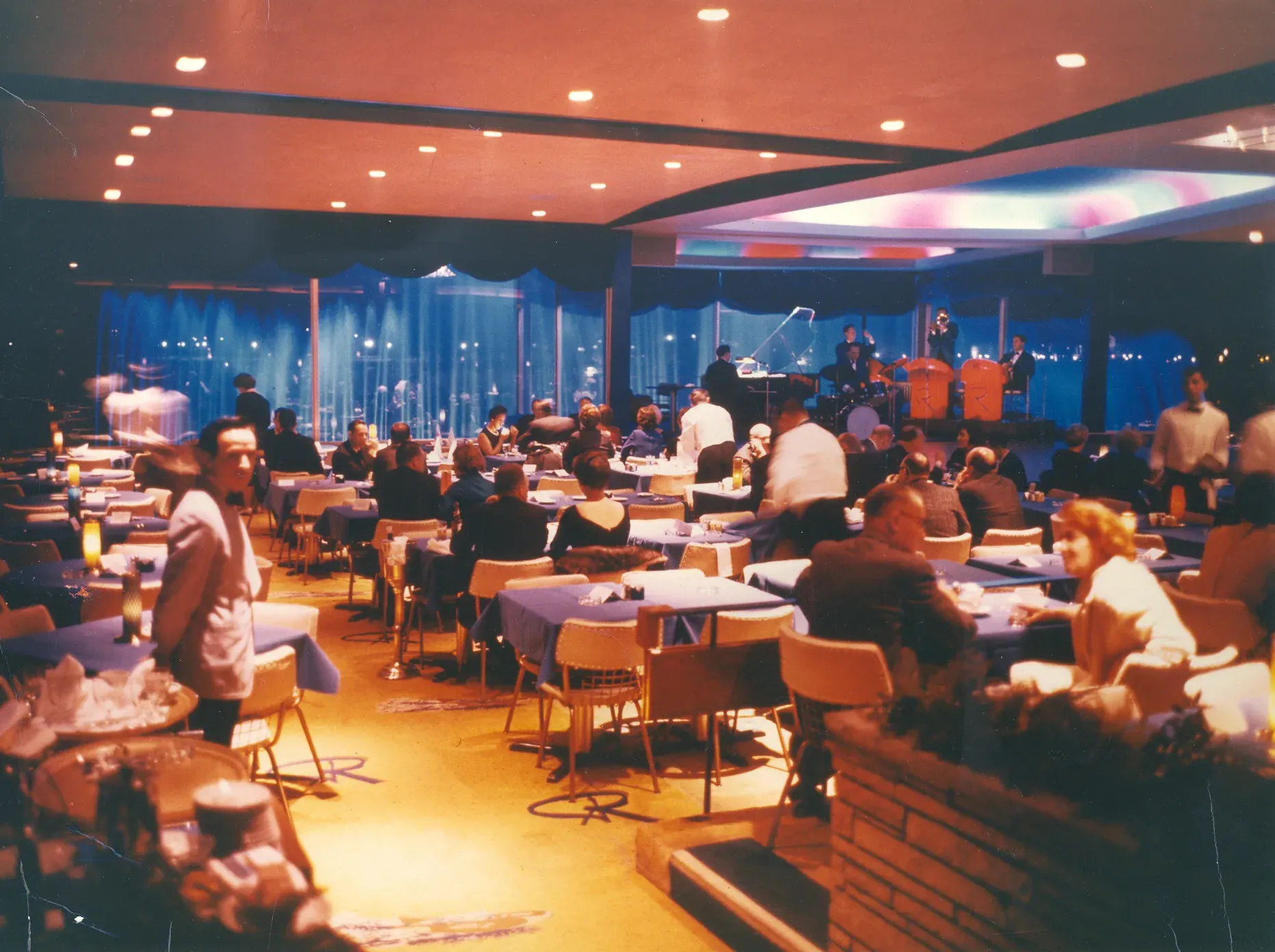
From 1958 to about 1979, the Roostertail was a supper club: you ate dinner at a linen table, then watched a floor show from the same chair. Six course dinners started at $3.75. There was no cover charge and no minimum. Coat and tie for the men, a house trio for the dancing, and the Detroit River outside the glass.
The shape of a night, from five thirty
The format barely moved for twenty years. Dinner service ran five thirty to nine thirty. You booked a table, ate a full dinner, and stayed in the same chair for the floor show. A period print ad put the whole offer in one line: cocktails, luncheons, dinners and private parties, with name entertainment and dancing nightly except Sunday.
The building was drawn for exactly that. Architect Edward M. Newman's plan sheet, revised in February 1958 and held today by the Detroit Historical Society, hand-labels a kitchen, dining rooms, a bar, a lounge facing the marina, and a large fan-shaped room ringed with tiered seat rows aimed at a stage. Dinner and a show were not added later. They were on the drawings four months before opening.
The backdrop was water. A lit fountain played outside the window wall behind the bandstand, so the band performed against the river. Guests ate at candlelit tables on a terrazzo floor with an R set into it. The bandstand chairs carried the same R, cut out of the seat backs.
Six courses from $3.75, no cover and no minimum
One artifact carries the whole price list. It is a direct mail advertising card, and it reads: Six Course Dinners from $3.75, served five thirty to nine thirty. Businessmen's Luncheon from $1.50, Monday through Friday. Then, in capitals, NO COVER, NO MINIMUM. American Express accepted.
The card is undated, so it dates itself another way. The return address reads "the Roostertail, 100 Marquette Drive, Detroit 14, Mich." Detroit 14 is a postal zone number, from the system the ZIP code replaced in 1963. The card was printed before that. So these prices belong to about 1960 rather than to a precise year.
Lunch was a trade in its own right. Printed luncheon menus survive for Tuesday and Friday, on different coloured card stock by the day, yellow and peach. Both open the same way: Fresh Jumbo Shrimp Cocktail, Fresh Fruit Cup Supreme, French Onion Soup au gratin. Friday adds Marinated Herring in Sour Cream, and Lobster Bisque.
Prices climbed across the run. A March 1968 newspaper display ad lists regular dinners at $2.90 to $6.95 complete, and admission to the venue's Broadway musical at $4.50 Monday through Friday, $5.50 Saturday.
Six Course Dinners from $3.75. Businessmen's Luncheon from $1.50. NO COVER, NO MINIMUM.
Direct mail card, printed before 1963
You called VAlley 3-2000 and wrote Detroit 14
The phone number outlasted almost everything else. VAlley 3-2000, printed as VA 3-2000 or VA.3-2000 depending on the piece. It is on a matchbook copyrighted in 1959. It closes a Detroit Jewish News notice of October 10, 1958 about the new waterfront restaurant's first documented headliner, Somethin' Smith and the Redheads. It is still running in a display ad in March 1968.
The address was written a dozen ways and always meant the same corner of the river. "At the foot of Waterworks Park on the waterfront." "Marquette Dr. on the Detroit River, next to Water Works Park." On the mail card, the full postal form: 100 Marquette Drive, Detroit 14, Mich.
People came, and quickly. Danny Raskin, who covered Detroit nightlife for the Detroit Jewish News and said he was there at the opening, wrote in January 1965 that thousands had flocked in during the first few weeks, more than the family had been prepared for. He was just as plain about the growing pains. The service and the food were sometimes indifferent, he wrote, and the prices at first too high. After the first season things got on an even keel.
The rooms had names of their own
Period print never describes one room. It names several. The same mail card promotes "the informal Admirals Club and Starlight Terrace," open for the summer, with dancing to the Joe Banket Trio Tuesday through Saturday. A magazine ad from the same era ran the banner line "Detroit's Smartest Supper Club" above a photograph of the building.
The glass is what people remembered. Roughly 25,000 square feet of floor to ceiling window gave the dining room close to 180 degrees of river. Newman's 1957 site plan shows why the water was never scenery. The parcel is bounded by the river to the south, Waterworks Park to the west, and an existing marina immediately east, drawn on the survey before the first wall went up.
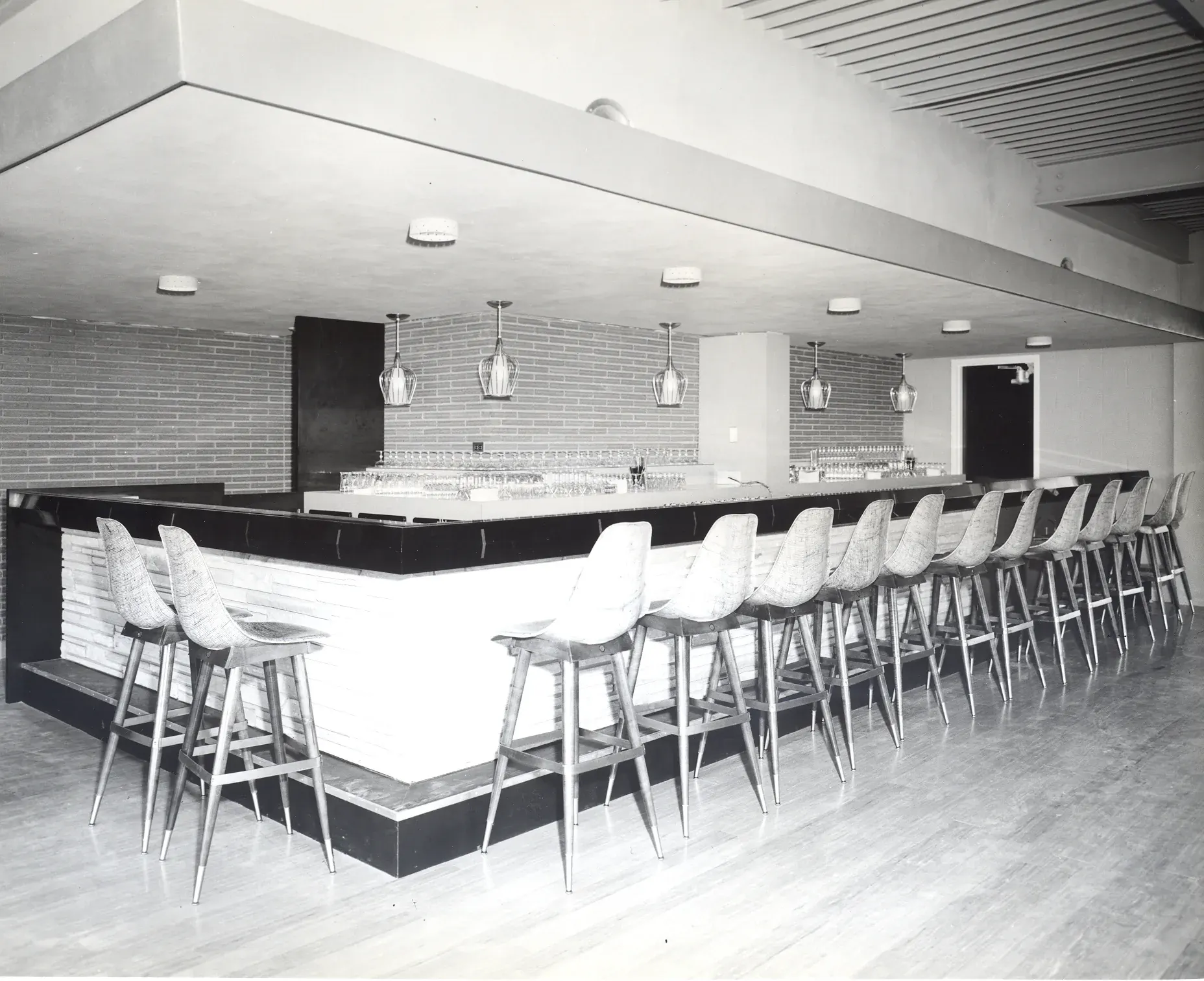
The bar in the family's photographs is a long counter lit from inside, with white stools in a row and pendant lamps overhead. Those rooms are still the rooms. Names and finishes have changed. The window wall still faces the same marina, and the kitchen and the bar are still the house's own.
The house band, and the drapes that fixed the glass
There were two kinds of music here every week: a resident band and a rotating headliner. The Joe Banket Trio played the summer rooms Tuesday through Saturday. Bandleader Johnny Trudell led the venue's own house band. By the end of 1967 the operation was large enough that when Paul Anka played the week of January 8, twenty three members of the Roostertail orchestra went with him to a charity benefit.
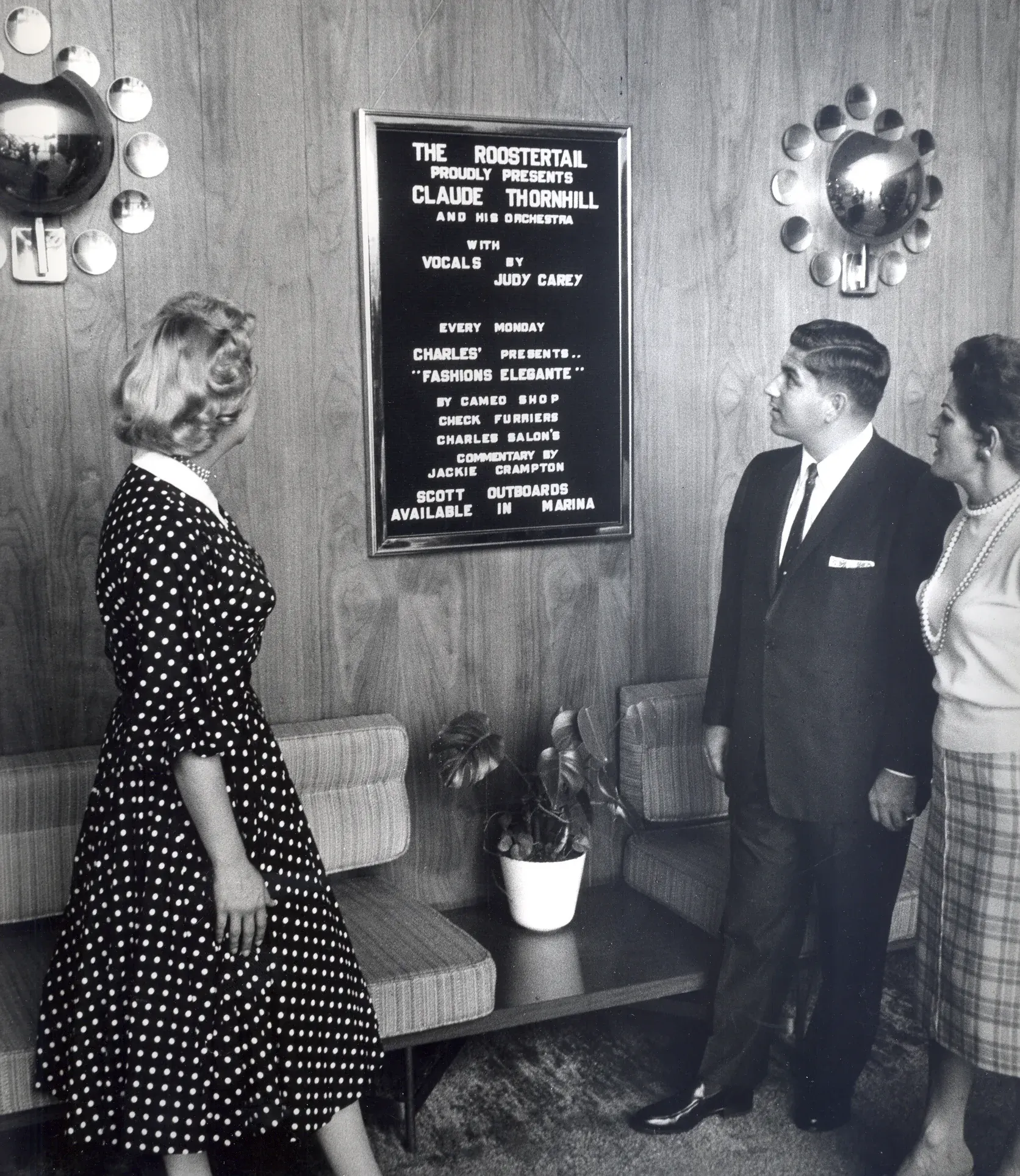
Headliners came in multi week runs, not one nighters. In October 1964 the bill was organist and comedian Lenny Dee for three weeks and the tenor Saverio Saridis for two. In the family's photographs the lobby letter board reads: THE ROOSTERTAIL PROUDLY PRESENTS CLAUDE THORNHILL AND HIS ORCHESTRA, WITH VOCALS BY JUDY CAREY.
All that glass had a cost, and the cost was acoustic. The room echoed. Trudell's word for the fix was "electronic drapes," installed to kill the reflection off the window wall. A glass room that size is a fine thing to sit in and a hard thing to play in.
The stage kept growing anyway. By March 1968 it had been opened to sixty feet, with new theatre lights and sets, for a run of full length Broadway musicals staged in house.
The Roostertail proudly presents Claude Thornhill and his Orchestra, with vocals by Judy Carey.
The lobby letter board, about 1959
Coat and tie, Monday fashion shows, outboards in the marina
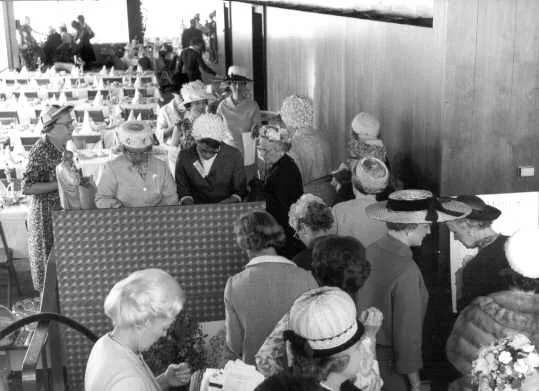
Men wore a coat and tie. Women's skirts, in the phrasing of the period, could not be short or very tight. The dress code was not decoration. It was the condition of the table.
The lobby letter board says more about how the place ran than any advertisement does. Below the orchestra it reads EVERY MONDAY CHARLES' PRESENTS "FASHIONS ELEGANTE." Below that: SCOTT OUTBOARDS AVAILABLE IN MARINA. A fashion show on Monday nights and outboard motors for sale next door, on the same board, to the same guests.
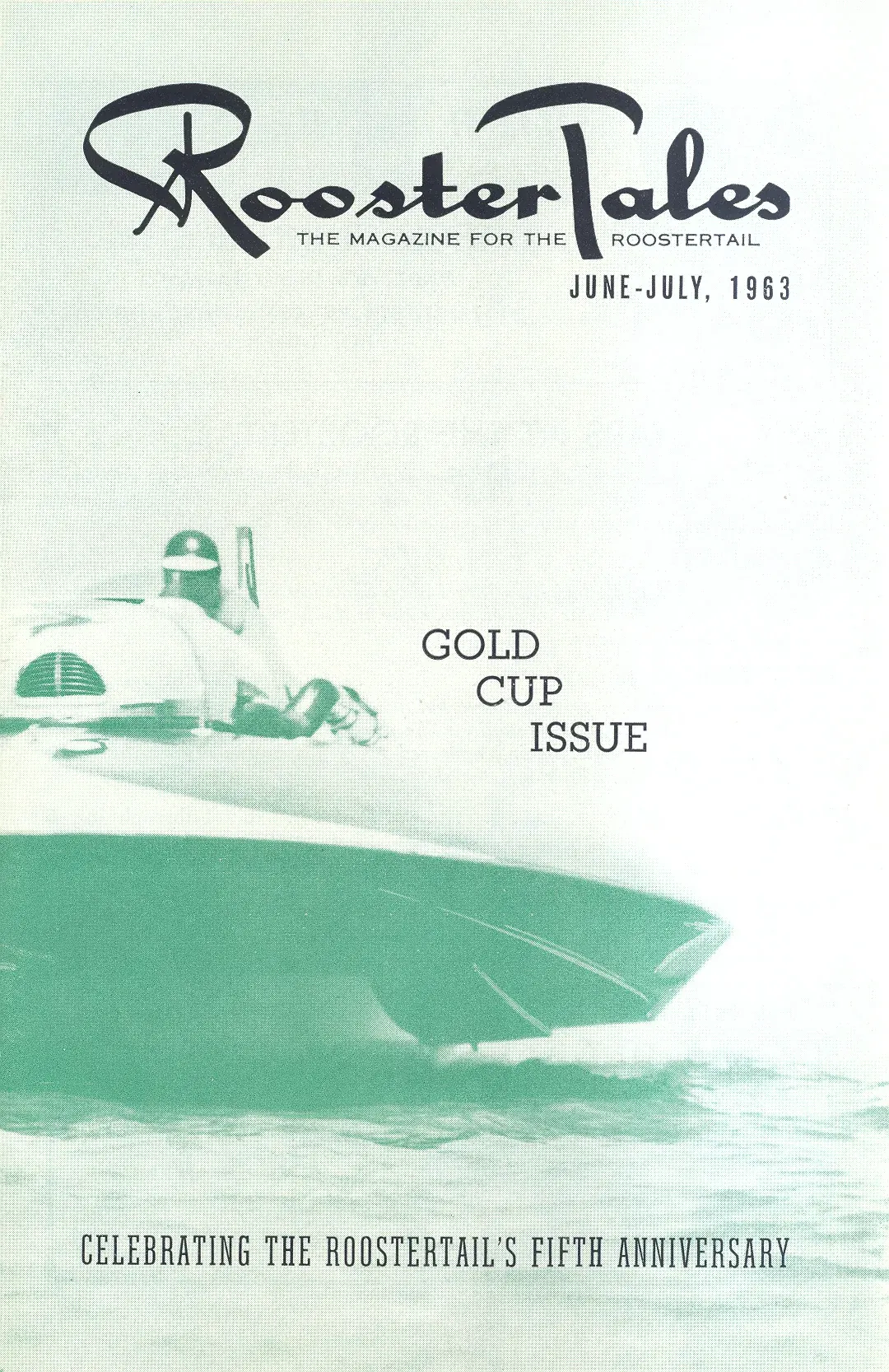
The club also published itself. RoosterTales, subtitled "The Magazine for the Roostertail," came out every two months. The July and August 1962 issue put four performers on the cover, among them the television comedian Frank Fontaine. Inside, a two page spread covers a Detroit Sports Broadcasters Association luncheon held in the building, where Tom Harmon, Hal Newhouser and Bennie Oosterbaan were inducted into the Michigan Sports Hall of Fame. The June 1963 issue was a Gold Cup number, and it marked five years open.
For its own description of itself, the house printed this on a matchbook copyrighted in 1959: "Detroit's Finest Restaurant and Cocktail Lounge ... home of the GALE race boats." The restaurant and the race team shared an owner and a river.
Detroit's Finest Restaurant and Cocktail Lounge ... home of the GALE race boats.
Matchbook, copyright Roostertail, Inc., 1959
The Upper Deck in 1965, and a quiet ending by 1979
In 1965 Joe Schoenith's twin sons, Tom and Jerry, added the Upper Deck: a separate room for a younger crowd, built for rock acts and dancing. By that spring it held roughly 400 people indoors and another 135 on an open air terrace. Downstairs the supper club kept its own audience and its own dress code. The building ran two different nights at once.
That split is the clearest thing about the late 1960s here. A 1968 live album recorded in the building was pitched at an adult supper club audience rather than the group's usual teenage market. The room could be both.
What did not happen next is worth stating plainly. The research behind this page found no evidence of a disco chapter at this address. No DJ nights, no disco programming, nothing in the archives searched. The room went from live bands and floor shows straight to private events.
By 1979 the Roostertail had stopped operating as a restaurant and nightclub and had become what it still is: a venue for private parties, benefits, weddings and special events. Nothing closed. The calendar changed hands. In January 1978 a single company holiday party here drew about 2,000 people. That was the shape of the business taking over.
The six course dinner is now a plated course at somebody's wedding. The floor show is now a first dance. The window wall, the marina and the river have not moved.
Questions people ask
- What was the Roostertail supper club?
- The Roostertail opened on the Detroit River in 1958 and ran for about twenty years as a supper club, meaning guests ate a full dinner and then watched a floor show from the same table. Dinner service ran 5:30 to 9:30 pm, followed by name entertainment and dancing nightly except Sunday. The kitchen and the bar were the venue's own, as they still are.
- How much did dinner cost at the Roostertail in the 1960s?
- A surviving direct mail card advertises six course dinners from $3.75 and a businessmen's luncheon from $1.50, Monday through Friday, with no cover charge and no minimum. The card is undated but prints the address as "Detroit 14, Mich.," a postal zone abolished in 1963, so those prices belong to roughly 1960. By March 1968 a newspaper ad listed regular dinners at $2.90 to $6.95 complete.
- What was the Roostertail Upper Deck?
- The Upper Deck was a separate room added in 1965 by Tom and Jerry Schoenith, the twin sons of founder Joe Schoenith, aimed at a younger crowd with rock acts and dancing. By spring 1965 it held roughly 400 people indoors plus another 135 on an open air terrace. The adult supper club continued downstairs at the same time.
- Was there a dress code at the Roostertail?
- Yes. Men were required to wear a coat and tie, and women's skirts, in the phrasing of the era, could not be short or very tight. The rule applied to the supper club through its nightclub years, roughly 1958 to 1979.
- What does VAlley 3-2000 mean?
- VAlley 3-2000 was the Roostertail's telephone number under the old exchange naming system, in which the first two letters of a word stood for the first two digits. It appears on matchbooks, mailers and newspaper listings from 1958 through at least 1968, usually shortened in print to VA 3-2000. Guests dialled it to book a table.
- Was the Roostertail ever a disco?
- No evidence of a disco era at the Roostertail was found in the research behind this page: no DJ nights, no disco programming, and nothing in the newspaper or artifact record. That is worth noting in any account of Detroit nightclub history in the 1960s and 1970s, because this room ran on live bands, orchestras and floor shows to the end. By 1979 it had shifted from a public nightclub to a private event venue.